
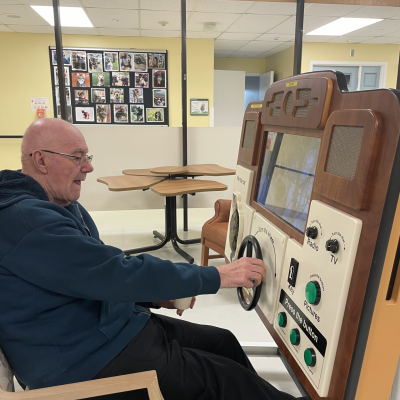
Eldercare Foundation recently visited the Gorge Road Health Centre’s Arbutus View unit, and caught up with Maryl, her husband Don who is a resident there, and their daughter Meghan. Don was sitting at a large mobile board complete with a screen, buttons, levers and simple instructions. The board, called an ABBY, had captured his attention, and he turned the wheel as the screen played a point-of-view shot of a long, sun-dappled Sunday drive. He would turn along with the corners, his mind and body syncing with the memories of driving.
Don has been on a dementia journey for a few years now and has lived at the Gorge for about a year and a half.
Don isn’t alone in his journey. Long-term care homes on Vancouver Island have the highest proportion of residents diagnosed with dementia in the province at 63%. This means that long-term care residents on Vancouver Island, on average, require more interventions and a higher level of supervision than their counterparts across the province.
Eldercare Foundation supports seniors across Vancouver Island in long-term care by funding equipment, entertainment, recreation therapy tools, home-like enhancements and so much more. When considering how to make the biggest impact for residents in long-term care, Eldercare evaluates evidence-based options that take those with dementia into account.
This is where the ABBY comes in. ABBY is a made-in-Canada technology that is embedded in the environment and designed especially for long-term care residents with dementia. With soft, calming video and music, as well as multiple options for the user to engage with the board, the ABBY has turned out to be incredibly popular with residents, families and staff alike. They arrive pre-programmed and ready to go but also have options for staff to load it with songs, videos and photos personalized for their residents.
Eldercare Foundation has purchased six ABBYs and distributed them amongst south Island long-term care homes. “The ABBYs have a reputation for being pretty interesting tools,” says Tom Arnold, Executive Director of Eldercare Foundation, “But we wanted to make sure they worked with the residents and staff at the long-term care homes that Eldercare supports before making a big investment. We started this as a pilot project, but the feedback has already been so positive.”
Thanks to our donors, Eldercare is making plans to purchase more ABBYs so people like Don and his family can enjoy all they have to offer.
“They are just incredible,” says Marielle Schultz, a recreation therapist at both Gorge Road Health Centre and Glengarry Long-Term Care. “My favourite thing about the ABBYs is the way that residents really self-initiate with the board. They can have staff or family involvement, but the pace and level of stimulation is so ideal for people with dementia that residents are willing to engage on their own, and we don’t see that with many other activities here.”
The ABBY fulfills so many functions, including restoring some independence for users, allowing residents to choose what they enjoy and when they want to engage. When living in long-term care, some residents aren’t able to exercise those daily choices as much as they used to.
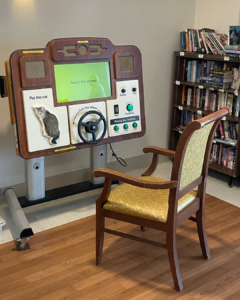
Maryl was sitting next to Don as he pets the soft fur of a cat shown on the board, bringing up the sound of purrs and kitten videos on the screen. “I love to see him enjoying the ABBY,” says Maryl. “It’s just so gentle but exactly at his pace. He doesn’t enjoy television anymore, and this is something that keeps him busy and works perfectly for where he is at right now.”
Meghan adds, “There’s just enough stimulation through the board. There are enough buttons and options to try, but it’s not complicated to use. It’s not overwhelming.”
While there is an element of independence to using the ABBYs, they can also help build connection with staff and loved ones, encouraging conversation, storytelling and shared moments.
As Don goes back to turning the wheel on the ABBY, Maryl says, “It’s just like when we used to drive the kids to Sylvan Lake. Do you remember, Don?”
Don is a man of few words these days. But he watches the screen, turns the wheel, nods, and says “yes.”